STEM CELL DONATION
Give someone a fighting chance, be their hope, be a force for life.
We look forward to a time when stem cell transplants are no longer needed. Where better treatments exist for rare diseases, blood cancers and other serious health conditions.
Until then, we need your help. More people are urgently needed to join the stem cell donor registry.
For many patients, a stem cell transplant from a healthy donor is their only chance of survival - and that match could come from someone just like you.
In Australia, approximately 80% of stem cell donations come from international donors. By joining the Australian stem cell donors registry, you’re helping give patients a greater chance of finding their lifesaving match.
Be the reason someone gets another tomorrow. Joining is quick and simple - just a cheek swab.
If you can’t donate, spread the word. Every conversation can make a difference, and help to save lives.
Join the registry today →
What are stem cells?
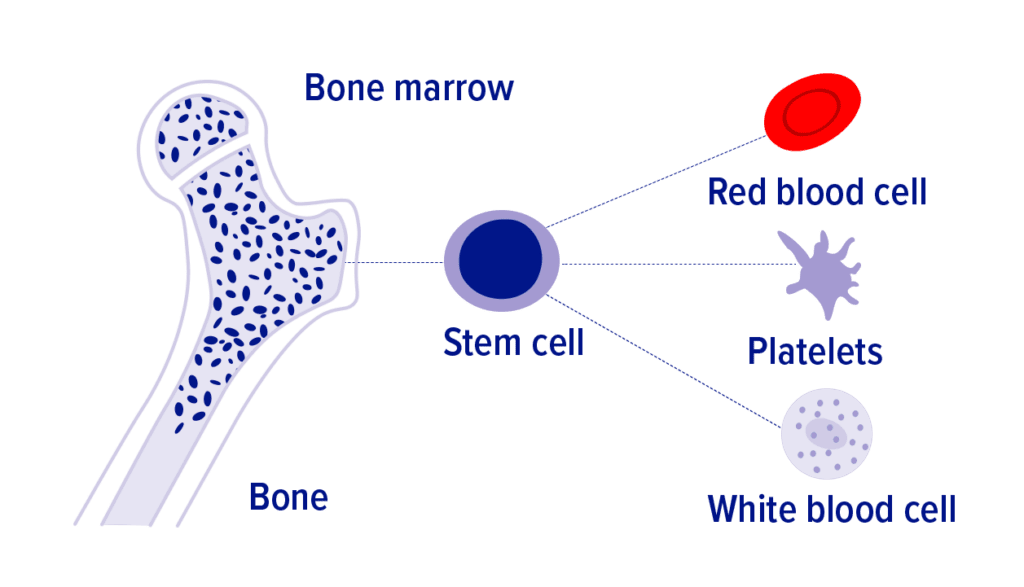
Stem cells are found in the bone marrow, which is the soft, spongy part in the middle of bones.
Stem cells are the 'building blocks' of the body as they can mature into any of the other normal blood cells, like:
Red cells which carry oxygen
White cells which fight disease and infection
Platelets which help the blood to clot / stop bleeding
What is a stem cell transplant (also known as a bone marrow transplant)?
A stem cell transplant is a lifesaving treatment for people with certain rare diseases, certain haematological conditions, blood cancers such as leukemia and other cancers.
A stem cell transplant is a procedure which replaces stem cells in people whose bone marrow has been damaged by diseases, and/or destroyed by large doses of chemotherapy and/or radiotherapy.
Donated stem cells are needed for a stem cell transplant. The new stem cells rebuild your body’s blood and immune system.
In some cases, patients can use their own stem cells, also donated umbilical cord blood can be used in some circumstances.
A stem cell transplant involves taking healthy stem cells from the blood or bone marrow of one person – and transferring them to another person. This is called an allogeneic transplant.
Types of stem cell transplants
A stem cell transplant involves receiving healthy stem cells through a line into a vein. There are several terms used to describe a stem cell transplant. This depends on where the stem cells are collected from:
Peripheral blood – a peripheral blood stem cell transplant
Bone marrow – a bone marrow transplant
Umbilical cord blood – a cord blood transplant
Once the stem cells enter the blood stream, they travel to the bone marrow. In the bone marrow they start to grow, divide, and mature into healthy blood cells. This is called engraftment.
Who can donate blood stem cells?
If you are aged 17 - 35 years and in good health, you can sign up! Stem cells in this age group result in the best outcomes for stem cell transplant patients.
Once you are on the register, you remain eligible to donate stem cells until the age of 60.
People with any sort of ethnic or indigenous heritage, this group is currently underrepresented on the registry.
Males make the ideal donor as they physically have more stem cells.
Check eligibility → https://stemcelldonors.org.au/why-you-matter/am-i-eligible/
Where and how do I register to donate stem cells?
Like blood donation, joining the stem cell registry is free and can help save lives.
There are two easy ways to join in Australia:
Order a free cheek swab kit delivered to your home via Stem Cells Australiahttps://stemcelldonors.org.au/join-the-registry/cheek-swab/
Join through Lifeblood - when next donating blood, let staff know you would like to register as a stem cell donor, and they’ll take a small blood sample during the visit and join you up.
A small blood or tissue sample is taken to determine your tissue type, which is used to match donors to patients. The result will be recorded on the Stem Cell Australia Donor Registry.
There are registries in many countries, and there is a possibility you may be a match for a patient in another country.
If you are identified as a potential match, further testing ensures safety for both you and the patient before donation proceeds.
Stem cell donors are volunteers, though withdrawing late in the process may have serious consequences for a patient awaiting transplant.
How do you donate blood stem cells?
Donating stem cells is easier than you think. There are two different ways to donate stem cells: Peripheral stem cell donation and bone marrow donation.
The type of donation you will be asked to make depends on what is best for the patient and what their doctor decides. Doctors might recommend one method, but the choice is always yours. Either way, most donors say it’s a small thing compared to the chance to save a life.
Watch the short video explaining the two ways of donating stem cells:
https://www.youtube.com/watch?v=xSpW50qouLY
Peripheral blood stem cell (PBSC) donation
PBSC donation is the most common method, used by 90% of stem cell donors.
A few days prior to donation, you will take medication (injections) which stimulate the bone marrow to produce more stem cells and release them into the blood stream, increasing the number of stem cells for donation.
You may experience some bone or muscle pain, fatigue, and/or headache while receiving injections. Side effects and their management will be discussed with you by the health professionals involved in the donation process.
On donation day, you’ll be hooked up to a machine that collects stem cells from your bloodstream. Blood is drawn from one arm, and the machine filters out the stem cells. The remaining blood is returned via the other arm.
These stem cells are then bagged and either used fresh, or they are frozen until the recipient is ready for their transplant.
This process is known as apheresis and is very similar to a long plasma donation.
Duration: The process takes about 4-5 hours, is usually completed in one session and involves minimal discomfort. You can watch a movie, listen to music, and bring someone to keep you company.
Recovery: Donors generally recover quickly, with mild side effects experienced which usually subside within a couple days after donation. Paracetamol can help any discomfort.
Bone marrow donation
For 10% of donors, stem cells are collected directly from the hip bone under general anesthetic (GA).
This method does not require any pre-work up, and you won’t feel a thing.
The stem cells are collected under GA by inserting a thin needle. The needle is then used to draw the liquid marrow from the back of the hip bones.
Duration: The process usually takes a total of 1 - 2 hours. After the procedure you will go to the recovery room to be monitored for a few hours and are normally able to go home that day.
Recovery: The body replenishes the donated bone marrow within approximately four weeks. You may feel a bit stiff and sore in the lower back area for a few days after the procedure, which some describe as similar to post-exercise soreness. You can take medication such as paracetamol for any discomfort. You may have some bruising around the procedure site the week after the donation.
Full recovery generally takes one week.
After your donation
You’ve done something amazing, and now your body needs to recover: Recovery times vary depending on the individual and type of donation.
Most donors return to their usual activities within days to weeks after donation.
Stem Cell Donors Australia keep in touch with you weekly until you can resume your normal activities. Three months after your donation Stem Cell Donors Australia requests you to see your GP to make sure you have fully recovered.
There is a lot of research into donor health which shows no long-term side effects for stem cell donation, and you will feel incredible knowing you have helped save someone’s life.
Donor Privacy and Confidentiality
Your information is collected and stored to ensure safe matching of potential donors.
If you are identified as a potential match your name will never be shared with the patient or their medical teams.
The information given by Stem Cell Donors Australia to other registries and treating doctors allows them to confirm you as a suitable match.
If you are confirmed as a match and agree to donate, only the hospital and health professionals involved in the donation process will know your identity.
In many countries, including Australia, there is a two-year period of which you and the patient will remain anonymous. After this period both donor and patient will need to sign a consent form to authorise the release of personal information. Some international registries do not allow any correspondence or contact between donor and patient.